

How a Reverse Mortgage Helps You Keep the House in a Divorce When You’re Retired
Short answer: A reverse mortgage divorce buyout lets a retired homeowner pull equity out of the marital home to buy out an ex-spouse and keep the house, with no required monthly principal and interest payment, and without qualifying for a new loan on a single income. It can also help the leaving spouse buy their next home. How much you can access comes down to your age, your home value, and the program, so the smart move is to have both a HECM and a proprietary option quoted side by side before anyone signs the decree.
Retirees get divorced too, and more than they used to
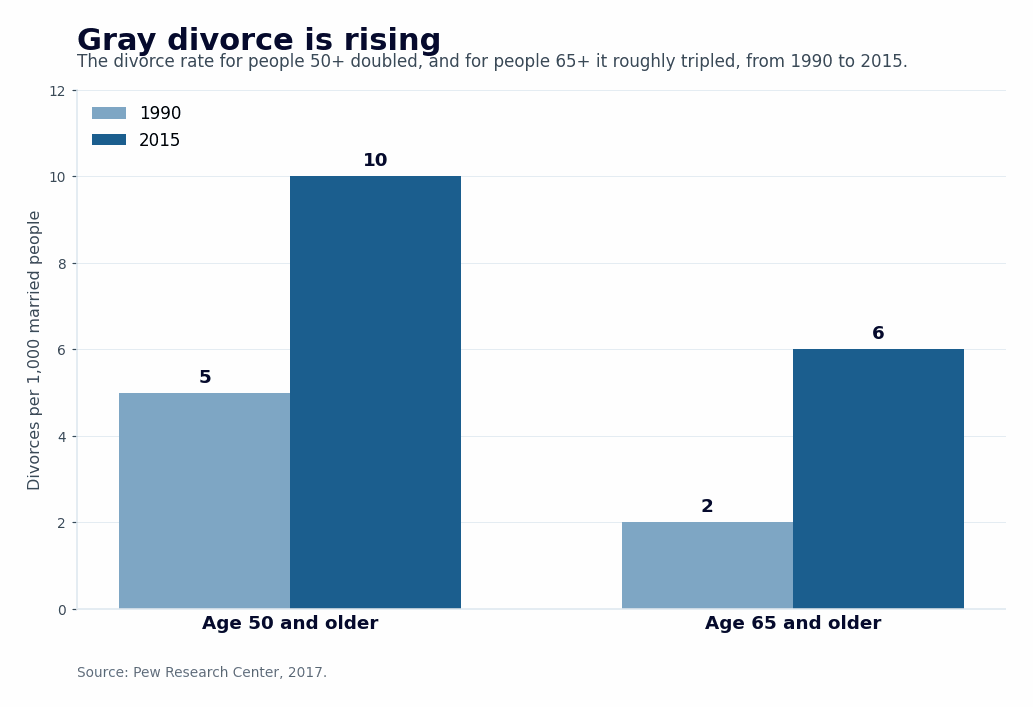
Here is something most people do not realize. Since 1990, the overall divorce rate in this country has actually gone down. But for people over 50 it has doubled, and for people over 65 it has roughly tripled. According to Pew Research, in 2015 there were 10 divorces for every 1,000 married people age 50 and older, up from 5 in 1990. So-called gray divorce is now common, and divorce in retirement is a different animal, because the income is different. That difference is the whole reason a reverse mortgage divorce buyout even exists as an option.
The problem shows up fast. When one spouse wants to keep the house, they usually have to refinance the other spouse off the loan. That means qualifying for a brand new mortgage. On one retirement income, with a new monthly payment, a lot of retirees simply do not qualify. That is where these settlements stall, and it is exactly the wall a reverse mortgage is built to get around.
“On one retirement income, a new mortgage payment is often the thing that will not pencil. A reverse mortgage removes the payment from the math.”
How a reverse mortgage divorce buyout works
The idea behind a reverse mortgage divorce buyout is simple. The spouse keeping the home takes a reverse mortgage against it, pulls out equity, and uses that money to pay the other spouse their share. There is no required monthly mortgage payment, and qualifying leans on your age and your equity rather than two paychecks. There is still a financial assessment to confirm you can cover taxes and insurance, but it is a very different bar than a full income-qualified refinance.
Three reasons retirees reach for it in a divorce. One, you may not have enough income to qualify for a traditional loan on your own. Two, pulling the buyout money out of your IRA or 401(k) can trigger a real tax bill and even bump your Medicare premiums. Three, draining your retirement savings to buy out a spouse can leave you short later, right when you need that money most. A reverse mortgage lets the house fund the buyout instead of your portfolio.
What a reverse mortgage divorce buyout looks like on a $500,000 home
How much you can pull out is set by your age and the program. Here is what it looks like on a $500,000 home at today’s rates. These are the gross principal limit figures, before closing costs, and the proprietary option (for example the Mutual of Omaha Secure Equity Plus) frees up more than the government HECM at the same age.
Illustrative, at today’s rates on a $500,000 home. HECM at 72 runs about $201,000 (0.402). The amount you can access moves with interest rates, which can change week to week: when rates are lower, you can pull out more. Ask me for today’s number for your home.
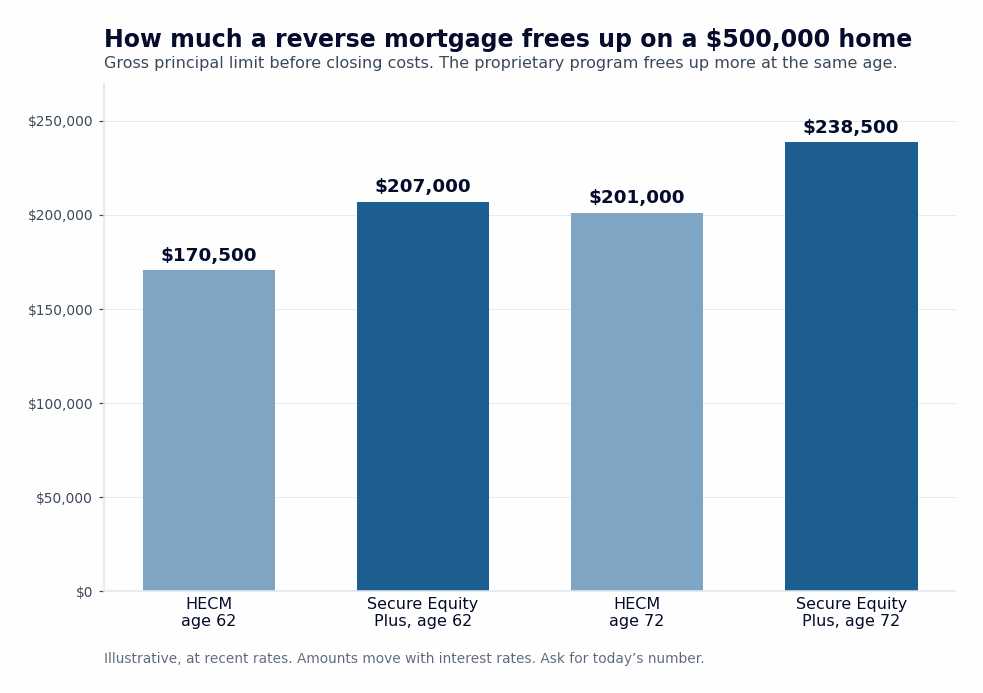
Now the honest part. On a $500,000 home owned free and clear, a 50/50 split means a $250,000 buyout. At 62, the reverse mortgage funds a large chunk of that, not all of it, and you would cover the rest from other assets. As you get older, or on the proprietary program, the gap closes fast. At 72, the Secure Equity Plus gets you close to the full $250,000. That spread is exactly why I quote both the HECM and the proprietary program side by side, instead of assuming one answer fits everyone.
Reverse Mortgage Calculator
Let’s calculate how much equity you can unlock.
A reverse mortgage is a loan. The balance grows over time and is repaid when the last borrower leaves the home. You keep the title, and you remain responsible for property taxes, homeowners insurance, and upkeep.
Can you access the full amount in year one to pay off a spouse?
This is the detail almost nobody gets right, and it can make or break a buyout. With a government HECM, there is a first-year rule: in the first 12 months you can generally take the greater of 60% of the principal limit, or your mandatory obligations plus 10%. A plain cash buyout to an ex is a discretionary draw, so by default it is capped at that 60% in year one.
Here is the workaround. If the buyout is structured as a recorded lien on the property, an owelty lien written into the divorce decree, standard in Texas and usable in the other states, the HECM pays that lien at closing as a mandatory obligation. That can unlock more than 60% in year one to satisfy it. This has to be coordinated with your divorce attorney and confirmed under current HUD rules, but it is the mechanism that makes a HECM buyout actually work.
And this is another reason the proprietary program often wins a buyout. Products like the Secure Equity Plus generally have no first-year cap. They fund as a lump sum at closing, so 100% is available on day one. Higher principal limit and full immediate access, both in your favor when the whole point is to hand your ex their share.
Buying your next home after divorce with a reverse mortgage
The buyout is only half of it. If you are the spouse leaving, a reverse mortgage can also help you buy your next home. With a reverse mortgage for purchase, you bring a large down payment from the settlement, finance the rest, and carry no monthly principal and interest payment. For a retiree splitting one household into two, that no-payment feature is what makes the second home affordable on a divided budget.
Other divorce problems a reverse mortgage can solve
- Both of you downsizing. Sell the marital home and each use a reverse mortgage for purchase, so the divided proceeds stretch to two homes instead of one.
- A one-income safety net. A reverse mortgage line of credit gives the spouse keeping the home a cushion during the transition, or a way to cover legal fees without raiding the IRA.
- Avoiding a forced sale. If selling in a down market or uprooting kids and grandkids is the worst outcome, the buyout keeps the house in the family.
- Equalizing the split. When the house is the biggest asset, one spouse keeps it and the reverse funds the other’s share, instead of selling just to divide the money.
The equity is already there, and that is why this works
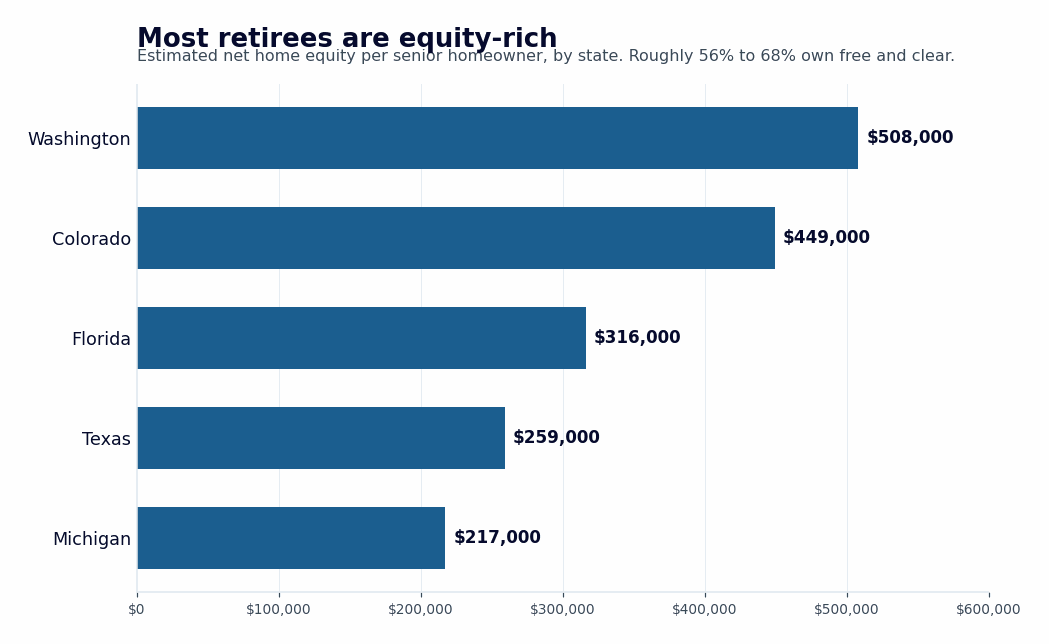
Most divorcing retirees are equity-rich and income-tight, which is the exact shape a reverse mortgage solves. Across the states I serve, roughly 56% to 68% of senior homeowners own their home free and clear. That leaves a large cushion of unencumbered equity to work with in a buyout.
| State | Typical senior home value | Own free and clear | Net equity per senior owner |
|---|---|---|---|
| Washington | $600,000 | ~60% | ~$505,000 to $512,000 |
| Colorado | $540,000 | ~58% | ~$446,000 to $452,000 |
| Texas | $325,000 | ~61% | ~$255,000 to $263,000 |
| Florida | $375,000 | ~64% | ~$312,000 to $320,000 |
| Michigan | $260,000 | ~66% | ~$214,000 to $221,000 |
The honest trade-offs of a reverse mortgage divorce buyout
Straight talk, because this is your home and your retirement. A reverse mortgage is still a loan. The balance grows over time instead of shrinking. There are closing costs, and on a HECM there is mortgage insurance. The home has to stay your primary residence, and you have to keep up taxes, insurance, and upkeep. HUD requires independent counseling before you can proceed, which is a good thing. Done right, coordinated with your attorney, it keeps you in your home. Done sloppy, it creates problems. If you want to pressure-test whether it fits, start with my is a reverse mortgage right for you guide.
One more thing on eligibility, because it varies by state. The government-insured HECM is available at age 62 in every state. Proprietary programs start earlier: age 55 in Colorado, Florida, and Michigan, age 60 in Washington, and age 62 in Texas. I am licensed in all five, so the right starting point depends on where your home is.
I studied divorce as part of my Certified Reverse Mortgage Professional coursework, because it comes up more than people expect. The best outcomes on a reverse mortgage divorce buyout happen when I am brought in early, alongside your divorce attorney, before the decree is final and the numbers are locked.
See how much equity you could access
Free and no-obligation. Get a personalized reverse mortgage estimate for your home, and I will quote the HECM and the proprietary program side by side.
Talk Through Your Situation →FAQ
Can I use a reverse mortgage to buy out my spouse and keep the house?
Yes. The spouse keeping the home takes a reverse mortgage against it and uses the proceeds to pay the other spouse their share, with no required monthly principal and interest payment. How much you can access depends on your age, your home value, and whether a HECM or a proprietary program fits best.
Do I need good income or credit to qualify?
Not in the way a traditional mortgage requires. Qualifying leans on your age and your equity. There is a financial assessment to confirm you can keep up with taxes, insurance, and upkeep, but there is no big monthly payment to income-qualify for, which is why this works when a refinance on one income does not.
Can I access the full loan amount in the first year to pay my ex?
With a government HECM, first-year draws are generally capped at the greater of 60% of the principal limit or your mandatory obligations plus 10%. If the buyout is structured as a recorded owelty lien in the decree, the HECM can pay it at closing as a mandatory obligation and unlock more. Proprietary programs typically fund as a lump sum at closing with no first-year cap. Coordinate the structure with your attorney.
What age do I have to be?
The government HECM is available at age 62 in every state. Proprietary programs start at age 55 in Colorado, Florida, and Michigan, age 60 in Washington, and age 62 in Texas.
Can I use a reverse mortgage to buy a new home after the divorce?
Yes. A reverse mortgage for purchase lets you put a large down payment down from your settlement, finance the rest, and carry no monthly principal and interest payment, which makes a second home affordable on a divided budget.
What if my ex is younger than 62?
In a buyout where your ex is leaving the home, their age does not matter. The loan is based on your age as the person staying, so you qualify on your own. Age 55 and up works through a proprietary program in Colorado, Florida, and Michigan, age 60 and up in Washington, and age 62 and up in Texas or on any HECM. The only time a younger age comes into play is if you both stay on the loan, which is unusual in a divorce. Not sure which applies to you? Call or text me at 720-449-6622.
Can my ex stay on the title?
Usually no, and that is the whole point of a buyout. The reverse mortgage pays your ex their share, they sign off the title, and you become the sole owner on the loan. If a spouse stays in the home but is not on the loan, they are a non-borrowing spouse, which carries specific HUD protections and its own paperwork. That is a coordination question for your divorce attorney and me, so bring us in before the decree is final.
Questions about keeping the house, or buying your next one, in your divorce? Call or text me at 720-449-6622. It is worth a conversation.
Want the full details before we talk? These guides cover everything, no local sales pitch, just the facts.
About Christopher Gibson
Christopher Gibson (NMLS #1910430) is an independent mortgage and reverse mortgage broker with C2 Financial Corporation (NMLS #135622), serving homeowners across Washington, Colorado, Texas, Florida, and Michigan. He holds a 5.0-star Google rating. Call or text 720-449-6622.
Read reviews of Reverse Mortgages & Home Loans with Christopher Gibson at C2 Financial
Google Business Profile → · Mortgage Matchup →