
Reverse Mortgages in Washington State

Who is a local reverse mortgage broker in Washington State? Christopher Gibson (NMLS #1910430) is an independent broker with C2 Financial Corporation (NMLS #135622), based in West Seattle. He helps Washington homeowners 62 and older, and age 60 and up on select proprietary programs, turn home equity into funds for retirement. Because the funds are loan proceeds rather than income, they are generally not subject to federal income tax.* Call or text 720-449-6622.

Updated

West of the Cascades, decades of Puget Sound appreciation have pushed the typical Washington home to about $603K, and much of that is equity in homes owned free and clear. A reverse mortgage is one way to put it to work without selling: erase a monthly payment, open a line of credit that grows, or fund the cost of staying put. Washington’s high values also mean more homeowners here clear the FHA limit and land in jumbo territory, so it is worth quoting both ways. I will walk you through whether it fits your home.

Aging in place in Washington, at a glance

Washington is a high-value, high-longevity, low-tax-rate state, and every one of those three works in favor of a reverse mortgage. The typical Washington home is worth $564,600 against $332,700 nationally, the effective property tax rate is 0.81% against 0.94% for the country, and people here live to 78.8 against 77.1. A long life in an expensive house with a modest tax bill is close to the ideal case for a growing line of credit. Below: the state against the national picture, then every city I serve side by side.

Washington against the national picture

Washington compared with national figures
MeasureWashingtonUnited States
Median home value$564,600$332,700
Monthly cost to keep a paid-off home$773$638
Effective property tax rate0.81%0.94%
Owners 65+ spending 30%+ of income on housing28%n/a
Life expectancy78.8 years77.1 years
Cost of living (price parity)107100

Compare retirement and aging in place in these Washington cities side by side

Tap a column heading to sort, and scroll sideways on a narrow screen. Each city name links through to its own page, where the same figures are set out with the local detail behind them, including the county income threshold for the senior exemption. Keep/month is roughly what it costs to hold a paid-off home each month, the property taxes, insurance, and upkeep you still owe once the mortgage is gone. When you are choosing where to age in place, weigh the things that are hard to change once you are settled: what you will pay in property taxes, the overall cost of living, the climate and how it affects getting around, and how close you are to good healthcare and to family. The Cascades split this table harder than any other state I cover: compare the snow and heat columns for Sequim against Spokane.

Retirement measures for every Washington city I serve, sortable
CityMedian home valueKeep/monthTax rateLife expectancySnow daysDays 90F+Build year
Anacortes$696,700$8150.67%78.5101989
Auburn$547,900$9561.00%81.1151991
Bainbridge Island$1,155,900$1,3130.77%79.5131989
Bellevue$1,340,300$1,3820.70%81.1221982
Bellingham$627,500$7710.69%79.6101986
Bremerton-Silverdale$439,400$6810.74%79.5131969
Burien$638,800$9060.94%81.1231966
Chelan$518,000$6090.64%79.39201984
Des Moines$597,000$8680.94%81.1231974
Edmonds$890,100$1,0080.70%79.3n/pn/p1974
Ellensburg$404,100$6470.82%79.810211991
Everett$565,300$7730.75%79.3111981
Federal Way$552,800$8310.85%81.1151984
Gig Harbor$767,100$9730.68%77.4221998
Hoquiam$228,200$6120.87%74.6101938
Issaquah$963,000$1,2230.76%81.1332002
Kent$587,800$9250.93%81.1231985
Kirkland$1,115,400$1,1950.72%81.1111984
Lacey$457,100$7170.83%78.3451996
Lakewood$461,200$8190.94%77.4151975
Lewis County$385,800$5780.67%75.6n/pn/p1980
Longview$361,600$6310.76%75.1271967
Marysville$567,900$7640.72%79.3211994
Mason County$411,800$5970.73%76.6n/pn/p1989
Mercer Island$2,000,001$1,5010.50%81.1221973
Moses Lake$310,000$5550.82%76.98331992
Mount Vernon$472,300$7240.90%78.5201989
Newcastle$1,205,600$1,2800.83%81.1231999
Normandy Park$1,014,100$1,3160.99%81.1231962
Ocean Shores$383,500$5760.65%74.6101997
Olympia$486,200$8240.90%78.3451982
Port Angeles$370,200$5980.76%77.3201968
Port Townsend$543,400$7010.73%80.1101981
Poulsbo$620,100$7590.73%79.5131996
Pullman$424,800$6500.79%78.115161984
Puyallup$551,800$8090.90%77.4151987
Renton$672,600$9340.89%81.1231988
SeaTac$519,700$8310.98%81.1231972
Seattle$938,600$1,1660.78%81.1221976
Sequim$408,700$6970.69%77.3101993
Snohomish$683,900$7880.80%79.3n/pn/p1978
Spokane$363,500$6230.81%76.916161961
Spokane Valley$382,300$6130.87%76.916161979
Tacoma$479,600$8790.93%77.4151967
Tri-Cities$370,700$5850.72%77.82341979
Tukwila$489,000$9300.90%81.1231981
Vancouver$462,400$6860.84%78.6181988
Walla Walla$393,600$7010.81%77.75371967
Wenatchee$433,700$5570.73%79.311351977
Whidbey Island$461,200$7540.78%80.8201990
White Center$645,200$1,0350.97%81.1231977
Yakima$297,600$5630.80%75.07311972

Tap any column heading to sort, and scroll the table sideways on a narrow screen. Figures: U.S. Census ACS 2020-2024 5-Year; County Health Rankings 2025; NOAA 1991-2020 Climate Normals. “n/p” means the Census does not publish a reliable figure at that size. This product uses the Census Bureau Data API but is not endorsed or certified by the Census Bureau.

Free tool: the Aging-in-Place Home Scorecard

Before you buy or commit to staying put, score any Washington home in about 15 minutes to see how ready it is for aging in place, and how a reverse mortgage can fund the upgrades.

Use the Aging-in-Place Scorecard →

Why Washington homeowners are using reverse mortgages to age in place

Decades of appreciation have made home equity the largest asset most Washington retirees own, while property taxes climb and fixed incomes do not. As a result, a reverse mortgage turns that equity into funds without a required monthly mortgage payment. Before you decide, it is worth weighing the pros and cons of a reverse mortgage.

Washington is not one housing market, however, but many. On the Eastside and across the Puget Sound region, decades of tech-driven growth have pushed values so high that many longtime owners have passed the FHA lending limit, which is exactly where jumbo and proprietary reverse programs come in. In more affordable markets such as Spokane, the Tri-Cities, and the coast, meanwhile, a standard FHA HECM usually covers the need comfortably. Because I broker across the whole state, I can match the right program to your county and your home value.

Here are a few numbers worth knowing:

$603KTypical Washington home value, years of built-up equity
$875KTypical King County (Seattle metro) home value
$1,249,1252026 FHA HECM lending limit, homes above it may fit a jumbo

Home values: Zillow, mid-2026. HECM limit: HUD/FHA 2026. Figures change, ask me for today’s numbers on your home.

What is your Washington home worth today?

Curious what your home could be worth, and how much equity you have to work with? Use my free home-value tool below. Enter your address for an instant estimate you can track over time, at no cost and no obligation.

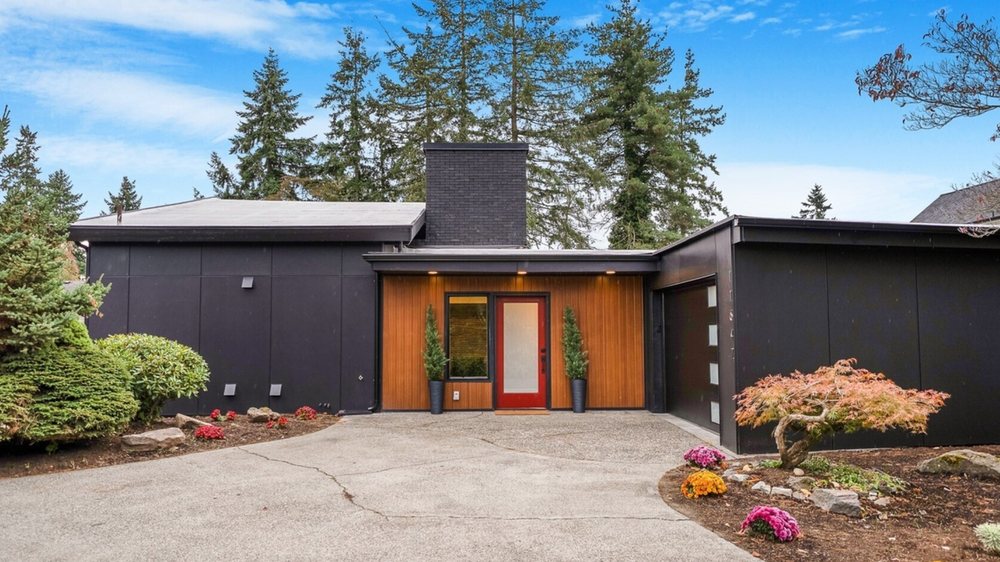
Reverse mortgage in Washington State: a modern Pacific Northwest home among evergreen trees

Estimate your equity with the Washington reverse mortgage calculator

How much can you borrow with a reverse mortgage in Washington? It comes down to three things: the age of the youngest borrower, current interest rates, and your home’s value (up to the 2026 FHA limit of $1,249,125 for a HECM). Older borrowers and lower rates mean a larger amount, often somewhere between 40% and 60% of the home’s value. The calculator below gives you a personalized estimate in about a minute.

Reverse Mortgage Calculator

Let’s run the napkin math on your equity.

A reverse mortgage is a loan. The balance grows over time and is repaid when the last borrower leaves the home. You keep the title, and you remain responsible for property taxes, homeowners insurance, and upkeep.

How should we deliver this information?

🔒 Your information is secure and never sold. Christopher Gibson, NMLS #1910430. Equal Housing Opportunity. Privacy Policy.

How Washington law treats a reverse mortgage

How does Washington law affect a reverse mortgage? The loan itself follows the federal HECM rules, so Washington adds no extra waiting period. The state-specific catch is property-tax programs: Washington’s senior tax exemption stays fully compatible with a reverse mortgage, but the separate senior tax deferral under chapter 84.38 RCW is not, and it can force the loan due. The details, dated where the date matters, are below.

Four things changed in Olympia in the 2025 and 2026 sessions, two of them in June 2026. Everything below is current as of August 2026 and dated where the date matters.

The deferral will stop your loan. The exemption will not.

Washington’s senior tax exemption is safe with a reverse mortgage, but the senior tax deferral will force the loan due. This is the most important paragraph on the page, and it is the opposite of the answer in Michigan. Washington runs two separate senior property tax programs and a reverse mortgage treats them very differently.

The senior property tax deferral under chapter 84.38 RCW is not compatible with a HECM. RCW 84.38.100 says the deferred amount “becomes a lien in favor of the state upon his or her property,” and RCW 84.60.010 puts tax liens ahead of “any recognizance, mortgage, judgment, debt, obligation, or responsibility.” Meanwhile 24 CFR 206.27(b)(3), which is a term of the mortgage you sign, says the borrower “shall not participate in a real estate tax deferral program or permit any liens to be recorded against the property, unless such liens are subordinate to the insured mortgage.” A state lien with statutory priority is the opposite of subordinate. If you are in the deferral program, that has to be resolved before a HECM closes, and if you have a HECM you cannot enter the program.

The senior exemption under RCW 84.36.381 is a different thing entirely and creates no lien. It reduces what you owe rather than postponing it, the test is ownership and occupancy, and a HECM is a deed of trust that leaves title in your name. Two practical notes: the income thresholds are set county by county against local median income, so the figure on your Pierce County neighbor’s letter is not your figure, and each city page carries the number for its own county. And ESSB 6162, effective 11 June 2026, raised the thresholds substantially for taxes payable in 2027 and after. In King County the top qualifying tier goes from $84,000 to $101,000. If you were told you earned too much a year or two ago, that answer may now be wrong.

One thing I will not tell you with certainty: whether HECM advances count toward “combined disposable income” for the exemption. The statutory definition in RCW 84.36.383 points toward no, because loan proceeds are not income, but no Washington agency has published a position on it and I am not going to invent one. Ask your county assessor in writing before you rely on it either way. There is also a live conflict on the disabled-veteran threshold: the current statute reads 40% service-connected for taxes payable 2027 onward, while the Department of Revenue’s consumer page still says 80%.

How does Washington’s senior property-tax exemption vary by county? Washington sets the income limit for the senior citizen and disabled property-tax exemption county by county, tied to local median income. For tax years 2024-2026 it ranges from about $40,400 in rural counties to $84,000 in King County. Below is every Washington county, grouped by region, with its average effective property-tax rate, the income limit to qualify for the exemption, and the higher income limit for the property-tax deferral program. Lower incomes qualify for a larger exemption across three levels; the figure shown is the income ceiling to qualify at all.

Washington senior property-tax exemption & deferral income limits by county (2024-2026)
CountyAvg. effective tax rateSenior exemption income limitDeferral income limit
Puget Sound / Greater Seattle
King0.83%$84,000$88,998
North Puget Sound
Island0.67%$54,000$57,370
San Juan0.53%$49,000$51,699
Skagit0.79%$48,000$50,487
Snohomish0.77%$75,000$79,578
Whatcom0.70%$52,000$54,779
Kitsap & Olympic Peninsula
Clallam0.72%$46,000$49,239
Grays Harbor0.80%$40,400$45,450
Jefferson0.71%$45,000$47,730
Kitsap0.77%$65,000$68,803
Mason0.73%$55,000$58,452
South Sound
Pierce0.91%$64,000$68,319
Thurston0.88%$59,000$62,519
Southwest Washington
Clark0.82%$62,000$65,548
Cowlitz0.82%$54,000$57,273
Klickitat0.62%$47,000$49,422
Lewis0.67%$48,000$50,932
Pacific0.72%$43,000$45,702
Skamania0.67%$58,000$61,846
Wahkiakum0.60%$48,000$50,678
Central Washington
Chelan0.71%$48,000$51,012
Douglas0.77%$46,000$48,822
Grant0.78%$46,000$52,064
Kittitas0.71%$43,000$46,713
Okanogan0.76%$41,000$45,450
Yakima0.79%$45,000$48,005
Tri-Cities & Southeast
Adams0.79%$41,000$45,450
Asotin0.72%$42,000$45,450
Benton0.78%$56,000$59,118
Columbia0.85%$43,000$45,836
Franklin0.73%$61,000$64,408
Garfield0.66%$47,000$49,562
Walla Walla0.85%$47,000$49,553
Spokane & Northeast
Ferry0.64%$40,400$45,450
Lincoln0.60%$48,000$51,177
Pend Oreille0.58%$40,400$45,450
Spokane0.84%$50,000$53,014
Stevens0.59%$45,000$47,431
Whitman0.75%$40,400$45,450

Sources: exemption & deferral income limits: Washington DOR, tax years 2024-2026; county average effective property-tax rates: county assessor data. Figures update periodically; verify current limits before applying.

WA Cares, and why Washington is different

Washington is the only state I serve with a public long-term care benefit, WA Cares, and it begins paying out on July 1, 2026. Washington is the only state I lend in with a public long-term care benefit, and as of 1 July 2026 it pays out. Workers contribute 0.58% of wages with no cap, and the lifetime benefit is $36,500 in 2026, indexed annually. Vesting is ten years of contributions, or three of the last six, at 500 hours a year. If you were born before 1 January 1968 you may qualify on a partial basis at one tenth of the maximum per year contributed. The in-state trigger is needing help with three activities of daily living for 90 days or more.

Be clear-eyed about the size of it. $36,500 is roughly four months of nursing home care in this state, or a year or two of a few hours of home help a week. It is a real cushion and it is nothing like full coverage. The gap between what WA Cares pays and what care actually costs is the gap a reverse mortgage line of credit is good at holding, and the credit line grows whether or not you draw on it. Voters kept the program in November 2024 by rejecting Initiative 2124, so it is not going anywhere.

No income tax today, and one asterisk worth knowing

Washington has no personal income tax, so Social Security, pensions, and IRA withdrawals go untaxed at the state level. Washington has no personal income tax, which is why Social Security, pensions and IRA withdrawals are untaxed at the state level here. The asterisk: ESSB 6346, effective 11 June 2026, imposes a 9.9% tax on individual income above $1,000,000 beginning 1 January 2028, with the first returns due in 2029. A repeal initiative filed 511,408 signatures in July 2026 and is headed to the November 2026 ballot, and separate constitutional litigation is pending. It would not reach a typical retiree at any rate, and reverse mortgage advances are loan proceeds rather than income, so they sit outside the tax base under any version of it.

The estate tax, which has moved three times in eighteen months

Washington has its own estate tax, and the exemption has moved three times in eighteen months, so confirm the current threshold. Washington is one of the few states with its own estate tax, and it has been a moving target. ESB 6347, effective 11 June 2026, undid the 2025 rate increase. For deaths on or after 1 July 2026 the exclusion is $3,000,000 and the top rate is back to 20%. Deaths between 1 January and 30 June 2026 got a $3,076,000 exclusion, so the exclusion actually fell mid-year. Washington has never allowed portability between spouses, which means a married couple needs deliberate planning to use both exclusions.

Where a reverse mortgage helps: Washington starts from the federal taxable estate, and IRC 2053(a)(4) deducts “unpaid mortgages on, or any indebtedness in respect of, property.” The HECM balance comes off. Only the net equity in the house is exposed. For an estate near the line, that is not a small thing, though it is a reason to talk to an estate attorney rather than to me.

One Washington rule that does not apply to a HECM

Washington’s own Reverse Mortgage Act adds strict disclosures, but it does not apply to the federal HECM most borrowers use. Washington has its own Reverse Mortgage Act at RCW 31.04.505 to 31.04.540, and it is substantive: sixteen-point bold disclosures, a minimum borrower age of 60, annual statements of advances and balance, a ban on requiring an annuity as a condition. It is worth knowing about, and it is worth knowing that it applies only to proprietary reverse mortgages, not to the federally insured HECM. The statute opens “A proprietary reverse mortgage loan must comply,” and the Department of Financial Institutions confirms its approval process covers proprietary products only. For a HECM the counselling requirement is the federal one at 24 CFR 206.41: independent, HUD-approved, before you apply, and it cannot be waived. If you are looking at a proprietary or jumbo program, the Washington act does apply and those protections are yours.

The houses themselves

The typical Washington home is about forty years old, which pushes up the insurance and upkeep costs of aging in place. The typical Washington home was built in 1985, which makes it about forty years old. That is past the service life of an original roof, water heater and furnace, and in much of the state past the original windows too. On a HECM this shows up at the FHA appraisal, which is a condition report as much as a valuation, and required work is handled through a repair set-aside funded from your own proceeds and capped at 15% of the maximum claim amount. It also pairs with the WA Cares benefit category for home modification: grab bars, a step-in shower, a ramp. Those are the cheapest things that keep somebody in a house, and between the two there is usually a way to fund them.

Sources: RCW 84.36.381 and 84.36.383 (senior exemption, as amended by ESSB 6162, 2026 c 163); chapter 84.38 RCW and RCW 84.60.010 (deferral and lien priority); 24 CFR 206.27(b)(3) and 206.41 (HECM lien and counselling requirements); chapter 50B.04 RCW and the WA Cares Fund (long-term care benefit); ESSB 6346, 2026 c 238 (individual income tax, effective 2028); ESB 6347, 2026 c 209 and RCW 83.100.020 (estate tax); RCW 31.04.505 to 31.04.540 and the Washington Department of Financial Institutions (proprietary reverse mortgage act); U.S. Census Bureau ACS 2020-2024 5-Year, table B25035 (median year built). Current as of August 2026. Washington changed four of these in the last eighteen months, so check the date on anything you read elsewhere.

The HUD counseling requirement, explained

Do I need counseling for a reverse mortgage in Washington? Yes. Every reverse mortgage borrower must complete an independent HUD-approved counseling session before closing, by phone or in person. It usually runs about an hour, is low-cost or free, and it exists to confirm you understand the loan before you sign. The approved agencies are listed below.

Federal HUD rules require independent counseling before you close, on every HECM, in every state. You meet with a HUD-approved counselor, by phone or in person, who confirms you understand the loan. It is a consumer protection, usually low-cost or free. You can find approved counselors through HUD’s HECM program, and the Washington Department of Financial Institutions offers consumer guidance. HUD publishes the approved counselors serving your county, so scheduling never has to stall your file.

HUD-approved counseling agencies in Washington

HUD-approved reverse mortgage (HECM) counseling agencies in Washington
AgencyAddressPhone
Credit.org450 Alaskan Way S, Seattle, WA 98104(509) 581-4927
Urban League of Metropolitan Seattle105 14th Ave, Ste 200, Seattle, WA 98122(206) 461-3792
American Financial Solutions500 Pacific Ave, Bremerton, WA 98337(888) 864-8699
Housing Options Provided for the Elderly5200 Meadows Rd, Ste 150, Lake Oswego, OR 97035(971) 207-7820
NeighborImpact, Madras Housing Center374 SW 5th St, Madras, OR 97741(541) 323-6567
NeighborImpact, Prineville Housing Center457 NE Ochoco Plaza Dr, Prineville, OR 97754(541) 323-6567

Counseling by phone, nationwide: available to Washington homeowners (availability can vary by agency, so confirm when you call):

National HUD-approved reverse mortgage counseling agencies (by phone)
AgencyPhone
Balance(800) 777-7526
Cambridge Credit Counseling(800) 757-1788
ClearPoint Financial Solutions(800) 251-2227
Consumer Credit Counseling Service of Maryland(800) 642-2227
Credit.org(800) 947-3752
GreenPath(888) 860-4167
Housing Options Provided for the Elderly (HOPE)(844) 432-6467
Money Management International(877) 908-2227
National Foundation for Credit Counseling(866) 698-6322
Navicore Solutions(866) 855-7736
Horizon Counseling(888) 315-4326

For the full, current roster of HUD-approved HECM counselors, call HUD at 800-569-4287 or search the HUD counselor directory.

Free guide: Your Home Can Help

My complete guide to reverse mortgages for Washington homeowners, the retirement squeeze, the myths, your options, real client stories, and what it really costs. No email required.

Download the Guide (PDF)

Learn how reverse mortgages work

New to reverse mortgages? Start with my complete reverse mortgage guide for the full national picture, then dig into the specifics below.

Types of reverse mortgages in Washington

There are two broad paths, and Washington’s high values make the second one matter more here than almost anywhere else.

  • FHA HECM: the government-insured standard. Take it as a lump sum, monthly payments, a line of credit, or a mix. It is capped at the FHA limit, which many Washington homes hit.
  • Proprietary / jumbo: built for higher-value homes, often well above $1M. It can unlock equity a standard HECM leaves behind, and some programs start at 60 in Washington.

For a plain-English rundown of each type, see the types of reverse mortgages guide.

Buying a home? Consider a HECM for Purchase (H4P)

A HECM for Purchase lets you buy your next home, a right-sized condo, a single-level rambler, a place closer to family, using a reverse mortgage, so you put down a portion and finance the rest with no required monthly principal-and-interest payment. It is a powerful way to downsize or relocate within Washington without draining savings.

How much you can access depends on age, rates, and value. Start your own estimate with the reverse mortgage calculator below.

HECM vs. jumbo vs. HELOC vs. HEI

A HELOC and a home equity investment (HEI) are the two common alternatives that are not reverse mortgages: a HELOC needs monthly payments and full income qualifying, while an HEI trades a share of your home’s future value for cash now. For a full side-by-side of the HECM, proprietary jumbo, HELOC, and home equity investment (HEI) options, see the comparison on my complete reverse mortgage guide. That same guide breaks down what a reverse mortgage costs and what happens to your home and your heirs. In most of Washington a home sits well under the 2026 FHA limit of $1,249,125, but in a few high-value pockets like the San Juan Islands or waterfront King County a home can top it, and that is where a proprietary jumbo reverse mortgage comes in.

Reverse mortgage requirements in Washington

Do you qualify for a reverse mortgage in Washington? The core requirements are the same across Washington: you are age 62 or older for the government-insured HECM, or age 60 and up on proprietary jumbo loans (Washington regulation sets a 60 minimum), the home is your primary residence, and you keep up with property taxes, homeowners insurance, and upkeep. There is no income or credit-score cutoff the way there is on a regular mortgage, though the lender does confirm you can cover those ongoing costs.

For the full checklist, including eligible property types and the financial assessment, see the reverse mortgage requirements guide. Condos are common around Puget Sound, and a condo qualifies only if its project is HUD-approved or clears FHA spot-approval, which I can check before you apply.

How the process works, step by step

Here is the path from first call to funding:

  1. Free consultation. We talk through your goals, your home, and whether a reverse mortgage even makes sense. If it does not, I will tell you.
  2. HUD counseling. You meet with an independent, HUD-approved counselor, required by HUD on every HECM, who confirms you understand the loan.
  3. Application & shopping. I compare programs across my wholesale lender network to find competitive pricing and the most available funds.
  4. Appraisal & underwriting. A licensed appraiser values your home, and the lender verifies the details. I keep your file moving.
  5. Closing & funding. You sign, you get a three-day right to cancel, and then your funds are available as a lump sum, line of credit, monthly payments, or a mix.

Why work with a mortgage broker, not a bank

As a broker with C2 Financial, I am not tied to one company’s rate sheet. I shop your loan across more than 30 wholesale reverse-mortgage lenders. Even a standard HECM is priced differently from lender to lender, so shopping the same loan can mean a lower rate or more available funds. Brokering also opens the door to the proprietary and jumbo programs a single bank cannot offer, including:

  • Finance of America HomeSafe and HomeSafe Second
  • Longbridge Platinum
  • Mutual of Omaha SecureEquity
  • Smartfi Choice

I broker through C2 Financial Corporation (NMLS #135622). For a program-by-program breakdown, see the types of reverse mortgages. For you, that scale means access, competitive wholesale pricing, and a lender for nearly every situation.

Reverse mortgages and aging in place in Washington, city by city

These are more than a list of links. Each city page is its own local guide to aging in place in that community, and in Washington the differences are stark: west-side values that push toward a jumbo, county senior-exemption income limits that swing by tens of thousands of dollars, and a climate that ranges from wet and mild in Seattle to dry and sunny in Spokane. Each page lays out the local home values, the county tax and exemption picture, and the resources that matter when you plan to age in place. If you are weighing whether to stay put in Washington, start with your city.

I have grouped the cities by region, the way people here actually search: Puget Sound and Greater Seattle, the North Sound, Kitsap and the Olympic Peninsula, the South Sound, Southwest Washington, and Central and Eastern Washington. Find your area, then open your city.

Puget Sound / Greater Seattle Metro

North Sound

Kitsap & the Olympic Peninsula

South Sound

SW Washington

Central & Eastern Washington

Do not see your city? Reach out, because I serve homeowners across all of Washington.

Reverse mortgage FAQs for Washington homeowners

Who offers reverse mortgages in Washington?

Christopher Gibson (NMLS #1910430) is an independent, Washington-licensed reverse mortgage broker with C2 Financial Corporation (NMLS #135622), based in West Seattle. He serves homeowners statewide.

How much can I borrow with a reverse mortgage in Washington?

It depends on the age of the youngest borrower, current interest rates, and your home value. Washington values are high, so many owners qualify for more than the national average, and higher-value homes may fit a jumbo program above the FHA limit. See how the principal limit sets your number.

Is HUD counseling required in Washington State?

Yes. Federal HUD rules require a session with an independent, HUD-approved counselor before closing, on every HECM, in every state. It is usually low-cost or free, and HUD publishes the approved counselors serving your county. Here is what to expect from HUD counseling.

What are the age and equity requirements?

A standard FHA HECM starts at age 62. Some proprietary programs start at 60 in Washington. You also need significant equity, and the home must be your primary residence. See the full reverse mortgage requirements.

Which Washington cities do you serve?

I serve homeowners across the entire state, and 48 Washington cities now have a page of their own, including Seattle, Bellevue, Tacoma, Everett, Spokane and Yakima. The city list higher up this page is grouped by region, so find your area and open your city. If your town is not on the list, reach out anyway. I am licensed statewide.

Are there special reverse mortgage rules in Washington?

Washington is a community property state, which means a spouse can have a legal interest in the home even if their name is not on the title, so lenders will typically require both spouses to be part of the transaction. Washington also has its own consumer loan rules for reverse mortgages, and state law requires the lender to give you a clear written notice about independent counseling, generally within three business days of your completed application. Beyond the federal HECM program, Washington separately regulates proprietary, non-FHA reverse mortgages offered to its residents. These rules are overseen by the Washington Department of Financial Institutions. HUD-approved counseling is required before you move forward, and the details should be confirmed for your own specific circumstances. See the details in how Washington law treats a reverse mortgage.

Have a question about a reverse mortgage in Washington? Call or text me at 720-449-6622.

About Christopher Gibson

Christopher Gibson (NMLS #1910430) is an independent mortgage and reverse mortgage broker with C2 Financial Corporation (NMLS #135622), serving Washington and Colorado. Mailing address: 9030 35th Ave SW, Seattle, WA 98126. Call or text 720-449-6622. More about Christopher.

Read reviews of Reverse Mortgages & Home Loans with Christopher Gibson at C2 Financial

Google Business Profile →  ·  Mortgage Matchup →

*This is general information, not tax advice. Reverse mortgage proceeds are loan advances rather than income and are generally not subject to federal income tax. Consult a CPA or tax advisor about your specific situation. Receiving loan proceeds may also affect eligibility for need-based government benefits such as Medicaid or Supplemental Security Income (SSI).

Let’s run the napkin math on your equity. Reverse Mortgage Calculator →