
Categories
For Real Estate Pros Special Offers

UWM 1-0 Buydown: Real Year-One Savings, Honest Trade-Offs

UWM is paying for a 1-0 temporary buydown right now. It drops a buyer’s first-year mortgage rate by a full percentage point. No out-of-pocket cost. On a $600,000 loan, that’s about $280 a month, or roughly $3,400 across the first 12 months. There’s a real trade-off: a slightly lower permanent rate exists without the buydown. The break-even between the two is around 3.5 years. The 10-year Treasury is back near where it was a year ago. The odds of a refinance window opening before then are good. For a West Seattle or Burien buyer stretching to make a $600,000 purchase work, that first-year breathing room can be the difference between buying now and waiting twelve months.
UWM Free 1-0 Buydown promotional graphic — bright neon arrow pointing at the words FREE 1-0 BUYDOWN on a dark background
UWM’s Free 1-0 Buydown promotion — currently funded by the lender at no out-of-pocket cost to the buyer.

What the UWM 1-0 Buydown Actually Does

UWM is running an aggressive promotion. It’s a “Free” 1-0 temporary buydown they fund out of their own pricing margin. The mechanics are simple. For the first 12 months, the buyer pays as if their rate is 1% lower than the note rate. In Year 2 through Year 30, the full note rate kicks in. The subsidy sits in an escrow account at closing and pays the difference each month during Year 1.

UWM is funding the buydown. It does not come out of the buyer’s pocket. It does not eat into a seller credit. It does not require any negotiation in the purchase contract. From a buyer’s cash-to-close perspective, it is genuinely free.

How Much Does It Save in Year One?

On a $600,000 loan, the 1-point rate reduction is worth roughly $280 a month in lower principal and interest. Over 12 months that totals around $3,400. Real affordability relief in the first year — when buyers are also absorbing moving costs, furniture, and repairs that nobody quotes them on the GFE.

For a buyer on the fence because the monthly payment was just outside their comfort zone, this changes the math. It reframes what’s actually affordable in the first year of ownership.

Where’s the Catch? The Real Trade-Off Against the Permanent Rate

Calling it Free is technically accurate from the buyer’s side. It is not free in the absolute sense. UWM is spending pricing margin on the Year 1 subsidy that could otherwise have gone toward a slightly lower permanent rate. On the same rate sheet, the same buyer can typically lock about a quarter-point lower rate for the full 30 years. No buydown, no Year 1 cushion. Just a permanently cheaper payment.

So the choice is a real trade-off. Year 1 cushion versus permanent monthly savings over the life of the loan. Anyone telling a buyer it is a no-brainer either way is oversimplifying.
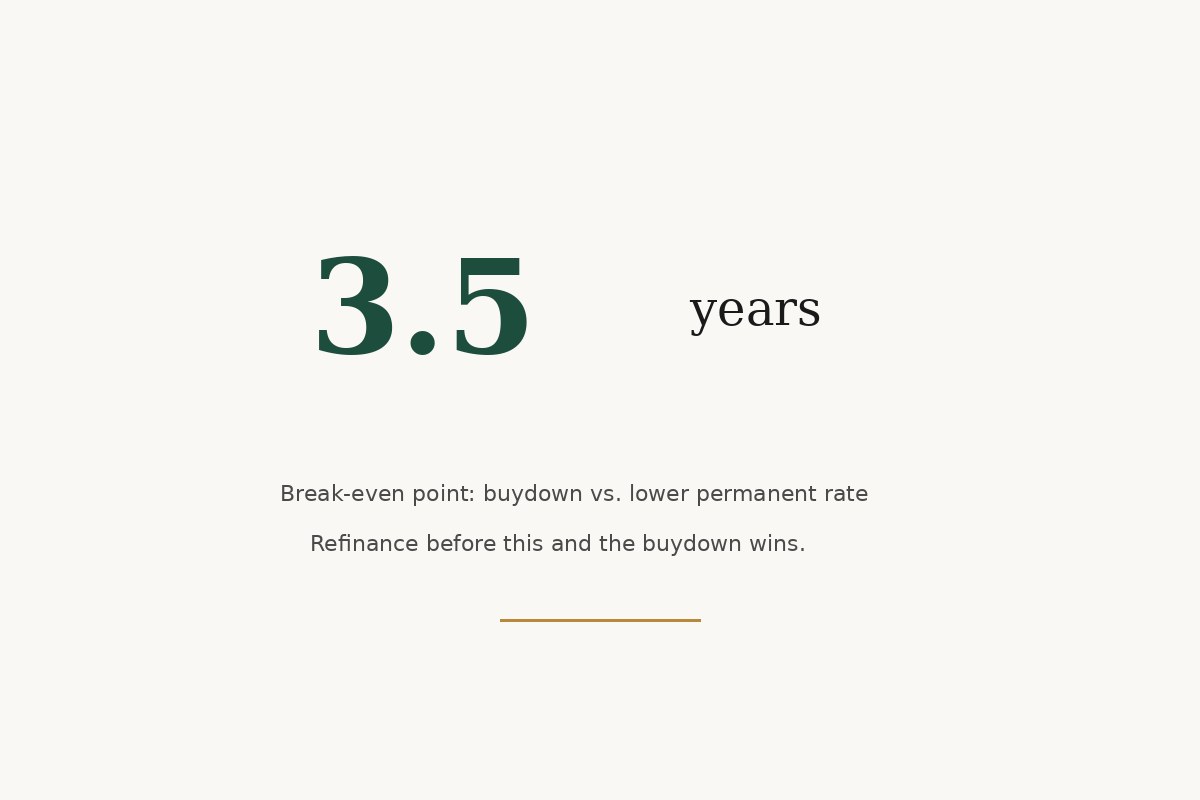
3.5 years break-even point for UWM 1-0 buydown versus lower permanent mortgage rate
The break-even point: hold the loan past about 3.5 years and the lower permanent rate beats the buydown.

When Does the UWM 1-0 Buydown Win?

The break-even between the buydown and the lower permanent rate works out to roughly 3 years 7 months. If the buyer refinances or sells before then, the buydown wins. If they hold the loan past that point, the lower permanent rate pulls ahead. And stays ahead for the rest of the term.

The math is straightforward. The buyer banks about $3,400 in Year 1 with the buydown. Then they pay roughly $110 a month more than they would have on the lower permanent rate, every month after that. Those $110 chunks chew through the $3,400 head start over about 31 months in Year 2 onward. Total time to break even: 12 plus 31, or 43 months.

Why a Refi Window Inside 3.5 Years Is More Likely Than Not

This is where the timing question matters. The 10-year Treasury drives mortgage rates more than any other single input. It closed at 4.46% as of mid-May. That’s up from a late-February low near 3.97%. That’s roughly half a percentage point of upward move in about ten weeks. It puts the 10-year right back near where it was a year ago.
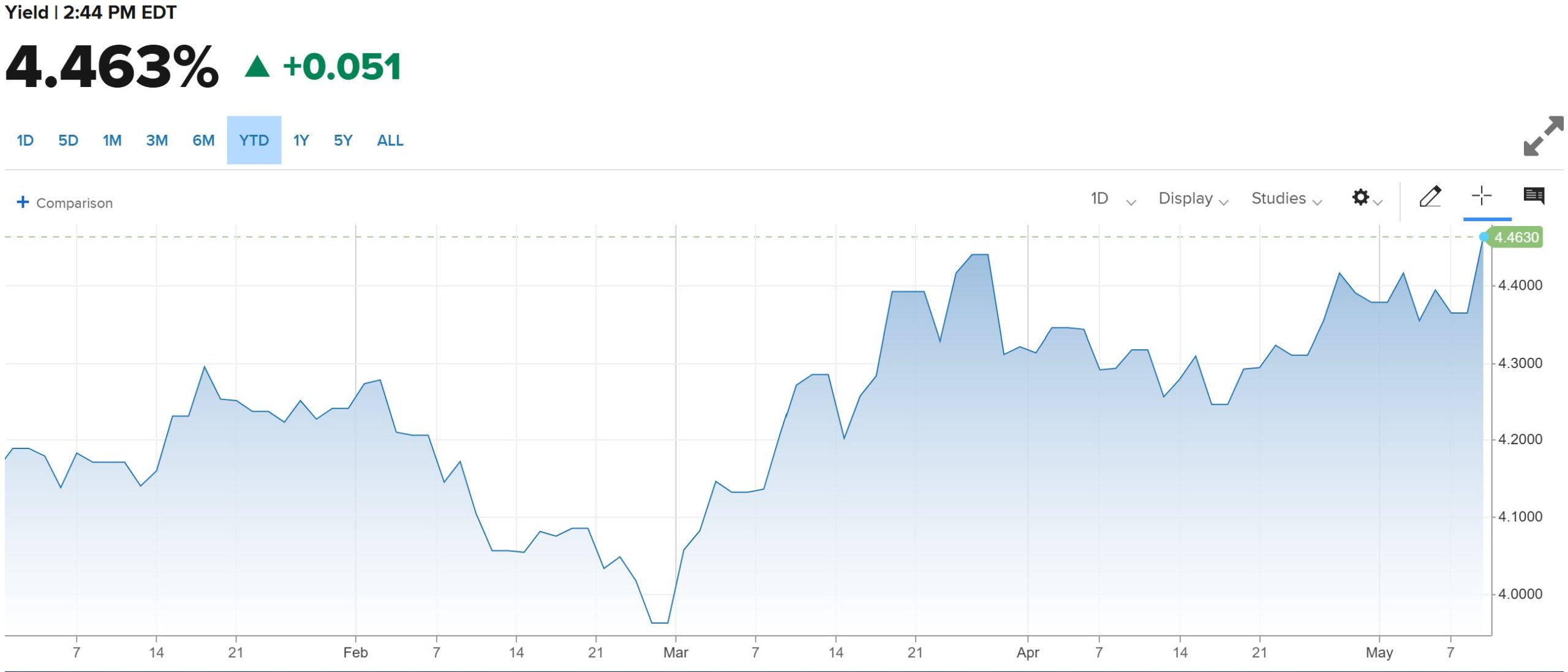
10-year Treasury yield year-to-date chart showing rise from late-February low near 3.97 percent to 4.463 percent in May 2026
10-Year Treasury YTD 2026: up from a late-February low near 3.97% to 4.46% in mid-May — almost half a percentage point of upward move in about ten weeks.

The directional implication is simple. There’s real room for the 10-year to fall back toward that February low. That happens if economic data softens or the Fed signals more accommodation. Most major forecasters expect 30-year fixed rates to drift lower through late 2026 and into 2027. That includes the Mortgage Bankers Association and Fannie Mae. Whether the move is gradual or sharp depends on the data, but the directional consensus is clear.

For a buyer choosing between the buydown and the lower permanent rate, that backdrop tilts the decision. A refinance opportunity opening in the next 24 to 36 months is more likely than not. That’s well inside the 3.5-year break-even window where the buydown wins.

How to Frame the Math for a Client on the Fence

The buyer needs three pieces of information to make this decision. None of them are about the buydown itself:

  • How long they realistically plan to hold the loan. The median U.S. homeowner stays put for 11.8 years. But the average mortgage only lives 5 to 7 years — because refinances end loans too. If they refi inside 3.5 years, the buydown wins.
  • What their cash-flow priorities look like in Year 1 specifically. First-year homeownership tends to be the most cash-strained year for any new owner — especially for Puget Sound buyers absorbing property taxes that are higher than what their lender estimated. The $3,400 Year 1 cushion has different value to a buyer who’s stretched than to a buyer who isn’t.
  • Their rate forecast posture. If they believe rates are flat or rising for the next several years, the lower permanent rate looks better. If they think rates are likely to drop and they will refinance, the buydown looks better. The 10-year’s recent move suggests the latter is plausible.

The math is not the hard part. The judgment about which lever to pull is. That is the conversation worth having before lock day.

FAQ

Is the UWM 1-0 buydown actually free?

Free from the buyer’s perspective — they pay nothing out of pocket for the buydown. UWM funds it from their pricing margin. The trade-off is that the same buyer could lock a slightly lower permanent rate without the buydown. So while there is no upfront cost, there is an opportunity cost compared to the alternative permanent rate.

What is a 1-0 temporary buydown?

A 1-0 temporary buydown means the borrower’s effective interest rate is 1 percentage point lower than the note rate for the first 12 months. After that, it steps up to the full note rate for Year 2 through Year 30. The Year 1 subsidy is funded by a lump-sum credit at closing. That credit sits in an escrow account. It pays the lender the difference each month during the buydown period.

How much does the UWM 1-0 buydown save on a $600,000 loan?

On a $600,000 loan, the 1-point reduction is roughly $280 a month in lower principal and interest. That runs for 12 months, or about $3,400 in total first-year savings. The exact figure varies slightly based on the underlying note rate, but the order of magnitude holds across the typical conventional loan range.

What happens if the borrower refinances during Year 1?

If the loan is refinanced or paid off before the 12-month buydown period ends, any unused buydown funds in escrow are typically applied as a credit toward the new loan. Or returned to the borrower per the lender’s specific buydown agreement. The funds do not disappear, but the exact treatment depends on UWM’s program terms. Verify in writing before the loan closes.

When does the buydown beat the lower permanent rate?

The break-even sits around 3 years 7 months on a typical loan. Hold the loan less than that, and the buydown wins. Hold it longer, and the lower permanent rate wins. Many mortgages do not survive 3.5 years anyway. Between refinances and home sales, the average mortgage lifespan in the U.S. is 5 to 7 years. Many end sooner when rates drop.

The Bottom Line

UWM’s “Free” 1-0 buydown is a meaningfully good product right now. Not because it’s free in the absolute sense. Because the current rate environment makes the trade-off lean in its favor. The buyer gets real Year 1 relief. The cost is borne by the lender. The break-even falls well inside the window where most mortgages get refinanced anyway. For a buyer on the fence about whether the monthly payment works, this is the kind of product that moves the needle.

The trade-off against the slightly lower permanent rate is the conversation worth having before the buyer commits to either path. Run the numbers on their actual loan size. Ask the right questions about how long they plan to keep the loan. The right answer is almost always specific to the buyer, not the product.

Related reading: how UWM’s 0% down product is qualifying more buyers. Also: the questions to ask a lender about a pre-approval. And how a reverse 1031 lets clients buy before they sell. For broader options, the full loan menu is here.

If you have a client weighing affordability options, or deciding between a temporary buydown and a permanent rate, send them my way. Happy to walk through the math on their specific loan.


Don’t just take my word on the UWM 1-0 buydown

If you want a read on how I work with clients before sending one my way, here’s where past borrowers and partners have weighed in:

Reviews on Mortgage Matchup ↗ Reviews on Google ↗

Follow along:

If you have a client weighing the UWM 1-0 buydown against a buy-down of the permanent rate, send them my way. We’ll run the actual numbers on their loan size, target rate, and realistic hold horizon.



Categories
Mortgage Education Special Offers Uncategorized

Doctor Loans Explained: 100% Financing for Medical Professionals

TL;DR: Doctor loans let specific medical professionals borrow up to 100% of a home’s value with no mortgage insurance. The loans qualify through Fannie Mae and Freddie Mac. As a broker, I now have access to a doctor loans program that competes head-to-head with the big-bank versions. That means your client doesn’t have to use Chase or Bank of America to get the structure.

What are doctor loans, in plain English?

Your client tells you they’re a physician moving to Seattle for residency. Or a dentist buying their first home after years of student debt. Here’s what they need to hear: doctor loans are designed for them. They don’t punish them for the way medical careers actually work. People sometimes call them physician loans or medical professionals programs. They let eligible borrowers finance up to 100% of the purchase price with no mortgage insurance. They also treat deferred student loans differently than a conventional loan. And they let future income from a signed employment contract count for qualifying.

For years, the big retail banks owned these conforming Fannie Mae and Freddie Mac-eligible programs. Chase, BofA, Wells, a few regionals. The pitch was always the same. “Open a checking account with us and we’ll do your mortgage.” That worked when there was no alternative. Now there is.

Who qualifies for doctor loans?

The eligible degree list matters. Clients (and frankly some agents) assume “doctor loans” means anything with “Dr.” in front of the borrower’s name. They don’t. Specifically, the program I have access to qualifies these designations:

  • Doctor of Medicine (MD)
  • Doctor of Osteopathy (DO)
  • Doctor of Dental Surgery (DDS)
  • Doctor of Dental Medicine (DMD)
  • Doctor of Pharmacy (PharmD)
  • Doctor of Veterinary Medicine (DVM or VMD)
  • Doctor of Podiatric Medicine (DPM)
  • Certified Registered Nurse Anesthetist (CRNA)
  • Medical residents and fellows holding one of the above degrees

Borrowers need an active employment contract in their field, or documented offer acceptance. They also need to practice without supervision. Residents and fellows are the exception. Non-occupant co-borrowers work too. However, their income can’t be more than 50% of total qualifying income.

What’s not on the list trips agents up every time. Chiropractors. Registered nurses. Physician assistants. Nurse practitioners (unless they’re CRNAs). Psychologists, optometrists, audiologists, dental hygienists. If your client falls in that gap, they’re a conventional or FHA borrower. Not a doctor-loan borrower. Worth knowing before you write the offer.

Doctor loans by the numbers: LTV, FICO, and DTI

For a primary residence purchase or rate-and-term refinance, one-unit:

  • 95% LTV up to $2,000,000 with a 680 FICO
  • 100% LTV up to $1,500,000 with a 680 FICO
  • 100% LTV up to $2,000,000 with a 720 FICO

Maximum DTI is 50% when the LTV is 95% or below. It’s 45% when LTV is between 90.01% and 100%. The program offers 15, 20, 25, or 30-year fixed terms. ARMs come in 5/6, 7/6, and 10/6 flavors. However, temporary rate buydowns aren’t eligible. Flag that for your client if their mom-and-dad-funded buydown was the plan.

Doctor loans vs. PMI: why no mortgage insurance matters

On a $1,000,000 loan at 95% LTV, monthly mortgage insurance on a conventional loan can run $300 to $600 a month. The exact number depends on the borrower’s credit and the MI company. That’s $3,600 to $7,200 a year your client throws away. The payment builds zero equity. It never goes to interest. It never reaches their tax accountant in any useful way. Doctor loans remove it entirely.

So when an agent tells me “the rate looks half a point higher than the conventional quote” — yes, sometimes it is. However, run the all-in payment with MI on the conventional. Doctor loans often win by $200 to $400 a month. Even with a slightly higher note rate. That’s the comparison your client should be looking at, not the rate alone.

Reviewing doctor loans payment comparison vs conventional mortgage with PMI on a laptop
Running the all-in payment with mortgage insurance on a conventional loan often shows doctor loans winning by $200–$400 a month — even with a slightly higher note rate.

Student loans: what gets excluded from DTI

This is the part that keeps doctors from qualifying anywhere else. For example: a new attending pulling $280,000 a year still has $400,000 in student loans in deferment. That normally kills mortgage qualification. A conventional underwriter wants to count 1% of the balance as a monthly payment. That’s $4,000 against the DTI right out of the gate.

Doctor loans exclude student loan payments from DTI when both of these are true. The borrower is currently in residency or a medical clinical fellowship. AND they’re qualifying based on the income they’re receiving during that residency or fellowship. Outside that lane — once they’re an attending, or qualifying on contract income that hasn’t started — the loan payment counts. But with flexibility on how:

  • If the credit report shows a real monthly payment, the underwriter uses that number
  • If the credit report shows $0 or no payment, the underwriter has options: a documented Income-Driven Repayment (IDR) amount, 1% of the balance for deferred or forbearance loans, or a fully amortizing payment using the actual repayment terms

The 1% rule sounds harsh. But it’s still better than what some lenders use. Those lenders apply the fully amortizing payment regardless of the actual situation.

Future income: signing a contract before the start date

Match Day is March 20th this year. New residents get told what city and what hospital. They sign a contract. They need housing — often before their first paycheck hits. Fortunately, doctor loans handle this with a projected income provision. A fully executed employment contract or offer letter qualifies the borrower. The start date can sit up to 150 days after the note date. For agents working with residents matching into UW Medicine, Seattle Children’s, Swedish, or Virginia Mason, this is the loan that turns “I can’t buy yet” into “let’s look at West Seattle and Beacon Hill this weekend.”

The contract has to spell out the position, start date, and salary. The only allowed contingencies are receipt of the medical license and normal administrative items. Background checks. Drug testing. Fingerprinting. The borrower also needs reserves to cover an extra month of PITIA (principal, interest, taxes, insurance, assessments) for every month between the first payment due date and the day employment starts.

Practical translation for agents: your client is house-hunting in February and starts work July 1st. This is the loan that lets them close in May. Build that into your timeline conversations.

Young physician couple settling in after using doctor loans for residency relocation
Doctor loans accept a fully executed employment contract for qualifying, with a start date up to 150 days after the note date — built for Match Day timelines.

Reserves and gift funds

Reserves scale with loan size and LTV:

  • Loans $100,000 to $1,500,000 at LTV under 95%: 0 months reserves
  • Loans $1,500,001 to $2,000,000 at LTV under 95%: 3 months
  • Loans $100,000 to $1,500,000 at LTV over 95%: 3 months
  • Loans $1,500,001 to $2,000,000 at LTV over 95%: 6 months

Gift funds work, and they count toward reserves. That’s a meaningful difference from a lot of conventional loan programs. Documentation is light. One month of bank statements for refinances. Two months for purchases.

The Match Day window: an agent’s calendar reminder

Match Day is when fourth-year medical students find out which hospital they’ll do residency at. They learn where they’re moving. Most institutions send new residents a welcome packet with information about the area. Many of those packets include preferred lender and realtor contacts. So if you’re an agent in a market with a major teaching hospital, March is when you should be making sure you’re on that list. I work with brokers and agents who get added to those packets every year. Doctor loans are part of why that referral chain works.

For Puget Sound agents specifically: the Match Day window catches residents heading to UW Medicine in West Seattle’s broader catchment, Virginia Mason, Harborview, and the Swedish system across Seattle and Bellevue. Burien, Tukwila, and Renton tend to attract the dual-career resident households where one spouse commutes north for work — keep those neighborhoods on the showings list.

Doctor loans FAQ

Can doctor loans be used for a second home or investment property?

No. This program covers primary residence only — purchase or rate-and-term refinance. If your client wants to keep their current home and buy a new one, the new home has to be their primary. For investment property financing, they’d need a different product.

Do residents and fellows really qualify, or is it just for attendings?

Residents and fellows holding an MD, DO, DDS, DMD, PharmD, DVM, VMD, DPM, or CRNA degree qualify. The program treats them well. Their student loans drop out of DTI when the qualifying income is the residency or fellowship income. Projected income from a signed contract works if the start date sits within 150 days of the note date.

What’s the minimum credit score and loan amount for doctor loans?

The minimum FICO is 680. Minimum loan amount is $100,000 for fixed-rate products and $350,000 for ARMs. Maximum loan amount is $2,000,000.

How is this different from the doctor loan at a big bank?

The structure is similar. Most banks offer 100% LTV no-MI for medical professionals. However, the differences show up in pricing and the fine print. Some banks tack on a “you have to be our depository client” requirement. They also cross-sell aggressively. As a broker, I shop the loan rather than tying it to a deposit relationship. That usually means a more competitive rate. And a lender who isn’t trying to sell your client a wealth management package on the side.

Do doctor loans work for a borrower with a recent credit event?

The program requires four years since a major credit event or notice of default. Mortgage and rent history needs to be clean — zero 30-day lates in the past 12 months. If your client had something happen during med school or residency that’s still on their report, run the dates with me before you assume they’re disqualified.

Don’t just take my word on doctor loans

If you want a read on how I work with clients before sending one my way, here’s where past borrowers and partners have weighed in:

Reviews on Mortgage Matchup ↗ Reviews on Google ↗

Follow along:

If you have a client matching at a Colorado or Washington hospital this Match Day cycle, or an attending who’s been told they need to put 20% down to avoid PMI — send them my way. Doctor loans are no longer a big-bank-only product.


Program details, guidelines, and pricing accurate as of April 30, 2026, and subject to change without notice. Loan approval is subject to underwriter review, credit qualification, and program eligibility at the time of application. Please contact me directly to confirm current program availability and verify that the terms outlined above are still in effect for your client’s specific situation.

Physician in scrubs holding house keys on craftsman home porch after closing on doctor loans financing
Categories
Blog Special Offers

We Will Pay for the Appraisal!

Let Us Take the Appraisal RiskWe Will Pay For The Appraisal

At Gibson Home Loans, we offer our clients an incredible advantage by taking the appraisal risk for them! We will pay for the appraisal and order it on the first day. This allows clients to maintain deadlines. Some clients may not want to take the risk before the inspection has been completed, which is why we are willing to take on the risk for them.
The appraisal cost will be reimbursed to us at closing, and the client will not pay the appraisal cost if they do not close. We offer a ten-day appraisal guarantee and we can close in as fast as 15 days with an appraisal.

Appraisal Process

To start, as we all likely know, appraisers are looking at the condition of what’s permanently part of or attached to the house. They are not looking at the décor, furniture, or anything that’s not affixed. What’s most important are the home’s physical characteristics (age, square footage, the number of bedrooms and baths, lot size, location, view) as well as their observable condition.

Appraisal Cost

In general, the cost of an appraisal varies from state to state. Most appraisals in Colorado range from $350 – $500, with the national average being around $335, according to HomeAdvisor. The cost of an appraisal is determined by the following:

  • The type and size of the home
  • Location of the home
  • Condition of the home
  • The amount of work and time required for the appraisal

While this may not include everything, these factors affect the cost. The amount of time, effort, and work that goes into the appraisal ultimately influences the price. For example, a larger home or multiunit property has more space to walk through and assess.
For a home with unique characteristics, the appraiser may have a difficult time finding accurate comps because certain features could make that home one of a kind. It can also be difficult for appraisers to find comps that are similar to a home when the home is located in a remote area with not much around it or a similar home nearby. When deeper research is required by the appraiser, it may end up taking more time.

Appraisal Expiration

For the most part, home appraisals are good for 120 days (4 months). If a client does not close on their home within that time, a client may need to have another appraisal. In some instances, an extension may be allowed. Appraisals have a short lifespan because market conditions change frequently. Most home sales from 6 months ago are likely very different from recent home sales, especially if the real estate market is unstable.

We’re Ready To Help

In order to help alleviate some stress for your clients, let us take the appraisal risk! On day one, we will pay for the appraisal to allow clients to better maintain deadlines.
We’re ready to help if you’re ready to work with us. Here is the link to our application to begin the process: http://chrisandbrandongibson.floify.com/apply-now

Gibson Home Loans

In order to give you more insight, here is a little bit more about us. We are brothers and Colorado natives and began in the mortgage industry in 2019, serving mostly friends and family, client satisfaction and referral business is our focus. We are an online resource for personalized mortgage solutions, fast customized quotes, great rates, & service with integrity.
As brokers licensed to originate loans in all of Colorado, we primarily utilize United Wholesale Mortgage to offer the highest quality service and technology to make the mortgage process as easy on our clients as possible. We reduce our compensation to attempt to secure the lowest rates and costs possible for our clients, as well. Lastly, we want to provide the best service AND the best rates.
Home Loan Originators Christopher Gibson & Brandon Gibson at C2 Financial Corporation: inforequest@gibsonhomeloans.com | (303) 332-5523
This licensee is performing acts for which a real estate license is required. C2 Financial Corporation is licensed by the Colorado Department of Real Estate, NMLS # 135622 NMLS# 1910935. Loan approval is not guaranteed and is subject to lender review of information. All loan approvals are conditional and all conditions must be met by the borrower. The loan is only approved when the lender has issued approval in writing and is subject to the Lender conditions. Specified rates may not be available for all. Rates subject to change with market conditions. C2 Financial Corporation is an Equal Opportunity Mortgage Broker/Lender. The services referred to herein are not available to persons located outside the state of Colorado.
#Colorado #HomeLoans #Mortgages #RealEstate #Denver #ColoradoLove #WereAllInThisTogether